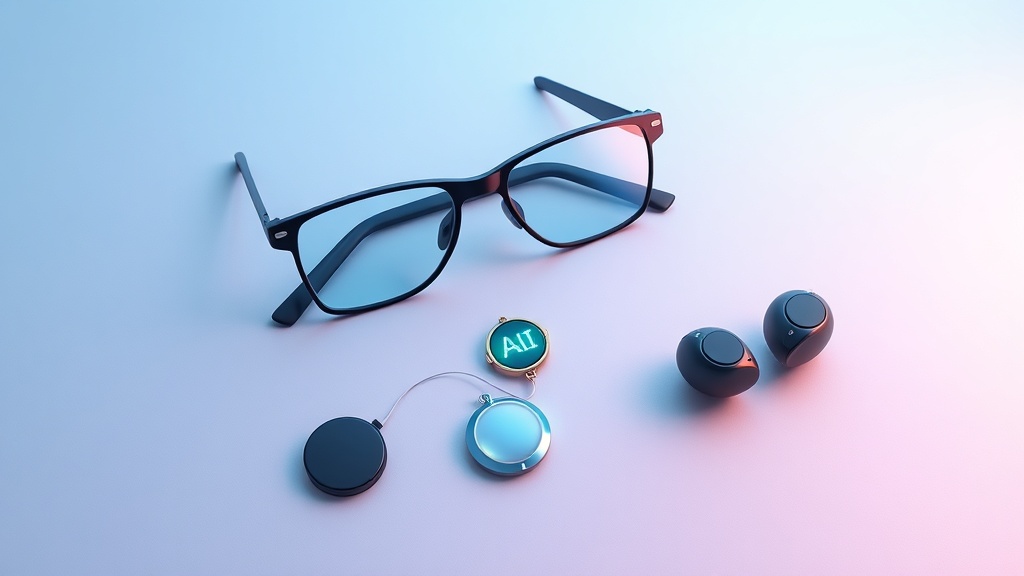
For years the smartphone was the only place AI lived. In 2026 that changed fast. Ambient AI, the kind that listens, sees, and answers hands-free, has quietly moved off the screen and onto your face, into your ears, and onto your lapel. Smart glasses, AI pins, and camera-equipped earbuds dominated the headlines at MWC 2026, and for the first time the technology feels less like a gadget demo and more like an everyday computing platform.
Smart glasses became the breakout category
Smart glasses are the clear front-runner in the race to become the next everyday device. Meta and EssilorLuxottica now control more than 80% of the market, having sold millions of units since the first Ray-Ban Meta glasses launched in 2021. In June 2026 Meta pushed the category further downmarket, announcing a new set of smart glasses starting at $299, at least $80 cheaper than its entry-level second-generation model.
The bigger leap is the display. Meta’s Ray-Ban Display glasses pair a wearable frame with a companion Neural Band and a 5,000-nit heads-up display, described as the first on smart glasses that is genuinely readable in direct sunlight. It surfaces exactly the bite-sized information you would want glanceable: turn-by-turn navigation, message previews, live translation captions, song identification, and quick AI answers, all without pulling out a phone.
Apple enters with a trio of AI wearables
Apple spent early 2026 signaling that it will not cede this space. According to reports from Bloomberg and others in February, the company is accelerating work on three AI wearables at once: camera-equipped smart glasses, an AI pin or pendant, and AirPods with built-in cameras. The common thread is vision. Cameras across all three products would let an upgraded Siri actually see the wearer’s surroundings and answer questions about what is in front of them. Production on the glasses could begin as early as December 2026, with a broader launch targeted for 2027.
AI pins, pendants, and camera earbuds fill the gaps
Not everyone wants to wear a computer on their face, and that is where AI pins and pendants come in. These screen-free companions clip to your clothing, capture audio and sometimes images, and lean entirely on voice and AI to be useful. The category is still finding its footing after some rocky early launches, but 2026 has been a test of whether truly screenless computing can finally feel natural rather than gimmicky.
Earbuds are evolving in parallel. Rather than just playing audio, the newest models are turning into voice-first assistants, with added cameras and sensors that let AI interpret your environment and health signals. Alongside them, smart rings and health bands keep adding deeper biometric tracking, so the ambient AI layer is spreading across the whole body, not just one device.
The real shift is where the AI runs
The most important 2026 development is not a flashier assistant, it is where that assistant actually runs. Manufacturers are moving wake-word detection, real-time translation, gesture recognition, audio cleanup, and health-pattern analysis onto local silicon inside the device itself. That on-device processing means lower latency, better privacy, and longer battery life. It is why newcomers like Brilliant Labs’ Halo, a 40-gram frame claiming 14 hours of battery, can leapfrog older designs. Qualcomm’s Snapdragon AR chipsets are powering much of this efficiency behind the scenes.
What it means for you
The takeaway for anyone learning AI in 2026 is that the interface is changing. The skills that mattered for chatbots, clear prompting, knowing what AI is good and bad at, and verifying its output, matter just as much when the AI is whispering directions in your ear or captioning a conversation in real time. The hardware is new, but the fundamentals of working effectively with AI are the same, and they are more valuable than ever.
Want to get ahead of the ambient-AI wave and actually understand the tools reshaping how we work and live? Explore our guides for plain-English, practical AI learning you can put to use today.


