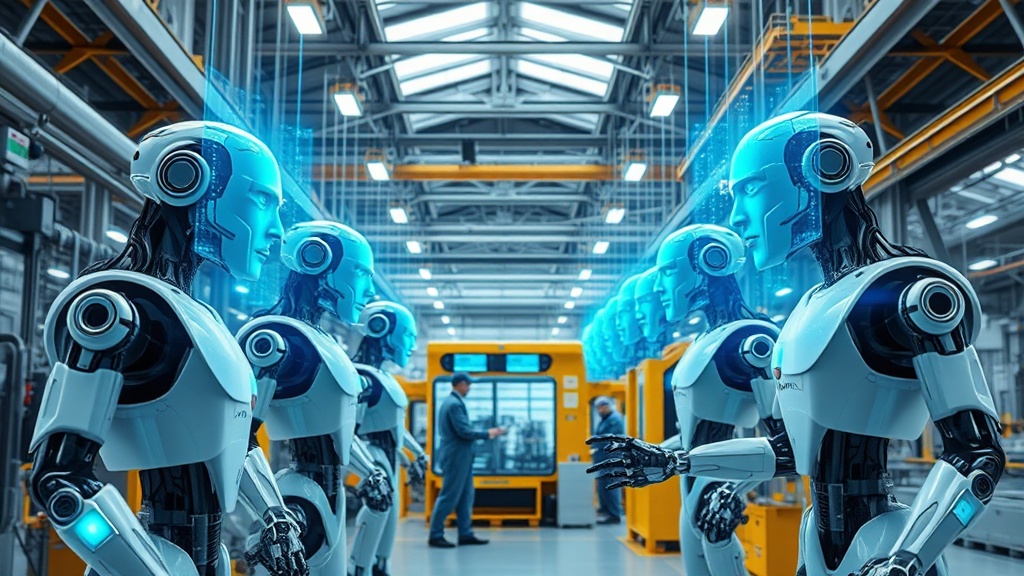
For years, manufacturing robots were fast but dumb—brilliant at repeating one motion, helpless when anything changed. In 2026 that is finally shifting. “Physical AI”—machines that can perceive the real world, reason about it, and adapt their actions—has reached what industry analysts are calling an inflection point, and it is happening on real production lines, not just in demo videos.
Robot Orders Rebound as Pilots Turn Into Deployments
The numbers tell the story. After a soft 2024, North American manufacturers ordered 36,766 robots worth roughly $2.25 billion in 2025, and 2026 is shaping up as the year those pilot programs give way to full-scale deployment. Just as notable is where the growth is coming from: general industry has overtaken automotive as the primary driver, with food and consumer goods posting a 51% year-over-year surge in robot orders. Around 70% of collaborative robot (“cobot”) orders now come from outside the auto sector—a sign that AI-driven automation is spreading well beyond the traditional assembly plant.
Humanoid Robots Log Real Factory Hours
The most eye-catching development is the arrival of humanoid robots on paying jobs. Figure AI’s robots have accumulated more than 1,250 operational hours at BMW’s Spartanburg plant, with multiple units working 10-hour shifts and contributing to the production of tens of thousands of vehicles. Its newer Figure 03 model is now rolling off a dedicated “BotQ” line at roughly one robot per hour, with hundreds of units already produced and autonomy steadily improving. Tesla, meanwhile, is scaling its Optimus program at Fremont, targeting live production tasks such as parts kitting and assembly assist while it chases a $20,000–$30,000 price point and a consumer launch later in the decade. Expectations should stay grounded—much of this is still early-stage, and independent verification of some deployment claims remains thin—but the shift from lab curiosity to shift worker is unmistakable.
The Four Technologies Doing the Heavy Lifting
Behind the headlines, four technology categories are quietly powering next-generation manufacturing. Edge AI puts inference directly on the machine, cutting the latency that used to make real-time decisions impossible and keeping sensitive production data inside the plant. Vision-guided systems let robots see and adjust to parts that are not perfectly placed, dramatically expanding the range of tasks a single machine can handle. Collaborative robots work safely alongside people instead of behind cages, lowering the barrier for small and mid-sized manufacturers. And digital twins—live virtual replicas of a factory—let engineers simulate, test, and optimize before touching the physical line, slashing the cost of mistakes. At Hannover Messe 2026, NVIDIA and its partners showcased how these pieces stitch together into AI-driven “physical AI” factories that train robots in simulation before deploying them for real. Each of the four addresses a different operational pressure—latency, quality, workforce, and predictability—and together they are what make today’s robots adaptable rather than merely fast.
Labor Shortages Are Forcing the Issue
The real accelerant is not hype—it is a workforce gap. The U.S. is already short roughly 200,000 welders, a figure projected to balloon toward 600,000 over the next decade. Manufacturers are adopting physical AI not simply because it is impressive, but because they increasingly have no other way to fill the roles. That economic pressure is why 2026 orders are holding steady even amid broader uncertainty, and why interest in pairing large language models with robotics jumped from 16% in 2025 to 35% in 2026 as companies look for machines they can instruct in plain language.
What It Means for Everyone Else
You do not have to run a factory to feel the ripple effects. The same perception-plus-reasoning breakthroughs powering warehouse robots are flowing into the AI tools professionals use every day. Understanding how these systems actually work—vision models, edge inference, digital twins, and the language models that increasingly sit on top of them—is quickly becoming a core skill rather than a niche one.
Want to get ahead of the physical-AI wave and understand the technology reshaping how the world builds things? Explore our guides for clear, practical breakdowns of the AI concepts driving 2026’s biggest shifts.
Sources
- MassRobotics – National Robotics Week 2026 Highlights AI-Driven Automation & Physical AI’s Manufacturing Impact
- NVIDIA Blog – NVIDIA and Partners Showcase the Future of AI-Driven Manufacturing at Hannover Messe 2026
- Manufacturing Dive – The Physical AI Craze and Other Automation Trends to Watch in 2026


