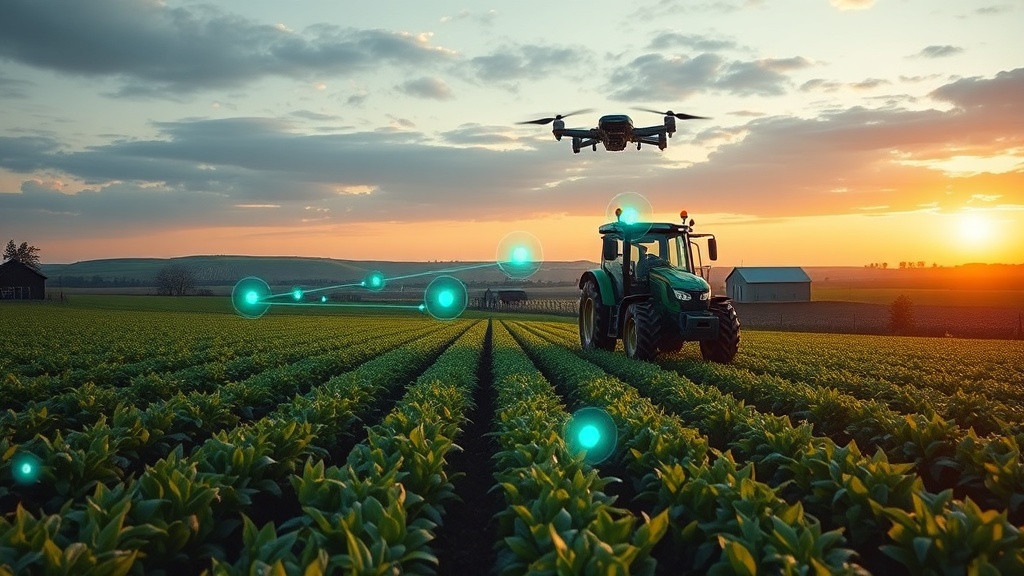
Agriculture has always been a business of thin margins, unpredictable weather, and long hours. In 2026, artificial intelligence is changing that equation faster than almost any other technology in the field’s history. From driverless tractors that plant through the night to drones that spot crop disease before the human eye can, AI is moving from experimental novelty to everyday farm infrastructure, and the numbers behind the shift are striking.
A Market Growing as Fast as the Crops
The money following AI into farming tells the story on its own. The AI in agriculture market is projected to grow from roughly USD 2.43 billion in 2025 to about USD 3.11 billion in 2026, on its way to an estimated USD 8.39 billion by 2031, a compound annual growth rate of nearly 22 percent. Some analysts are even more bullish, valuing the sector at USD 5.9 billion in 2025 and forecasting a climb toward USD 77 billion by 2036.
Early-2026 funding data shows more than USD 500 million flowing specifically into agricultural machines rather than software apps, a sign that investors now see hardware autonomy as the real prize. Adoption is following the capital: in 2024 roughly 58 percent of large-scale commercial farms reported using AI for crop management, up from 49 percent the year before.
Autonomous Tractors Take the Wheel
Perhaps the most visible change is the arrival of self-driving farm equipment. Industry forecasts suggest that by 2026 more than 35 percent of field tractors in the United States will offer some form of autonomous operation, and over 18 percent of new tractor sales globally are expected to be robotic or semi-autonomous.
These machines combine GPS, LiDAR, on-board cameras, and AI controllers to weed, plant, spray, and harvest with minimal human input, often managed remotely from a smartphone or tablet. For farmers facing chronic labor shortages, the appeal is obvious: a driverless tractor does not tire, does not need a lunch break, and can run around the clock during a narrow planting window.
Drones and Precision Agriculture
Above the fields, AI-powered drones have become a core scouting tool. The global agriculture drone market, valued at about USD 3.37 billion in 2025, is projected to reach roughly USD 21.59 billion by 2033. Drone analytics already appear in an estimated 28 percent of on-farm AI applications, especially on large commercial operations.
The payoff is precision. By fusing satellite imagery, drone surveys, and ground sensors, AI systems calculate exactly how much water, fertilizer, or pesticide each small plot needs, cutting waste and protecting soil. Reports credit AI tools with driving an average yield increase of around 27 percent across staples like maize, wheat, and rice, a meaningful gain in a world trying to feed a growing population on shrinking arable land.
Smarter Livestock and Conversational Farm Management
The revolution is not limited to crops. AI-driven livestock monitoring is expanding quickly, with more than 5 million cattle now fitted with smart sensors that track movement, body temperature, and feeding patterns in real time. Computer vision systems flag sick or distressed animals early, and adoption of AI in livestock health monitoring grew roughly 19 percent in the past year.
Meanwhile, 2026 farm management platforms are embedding generative AI directly into their dashboards. Instead of digging through charts, a grower can simply ask which fields need irrigation first or how an incoming storm might raise disease risk, and receive a plain-language recommendation drawn from sensor data, weather models, and years of field history.
The Roadblocks That Remain
For all the momentum, AI farming is not yet universal. High upfront costs remain the biggest barrier: an AI-powered drone system can exceed USD 10,000 per 100 acres, and autonomous machinery carries a steep price tag that keeps many small and mid-size farms on the sidelines. Connectivity gaps in rural areas, data-ownership questions, and a learning curve for older operators all slow the rollout. Still, as costs fall and results compound, the direction of travel is clear.
AI in agriculture is no longer a glimpse of the future; in 2026 it is feeding people today. Whether you farm for a living or simply want to understand the technology reshaping our food supply, learning how these tools actually work is the smartest investment you can make. Explore our guides to get up to speed on the AI systems driving this transformation.


