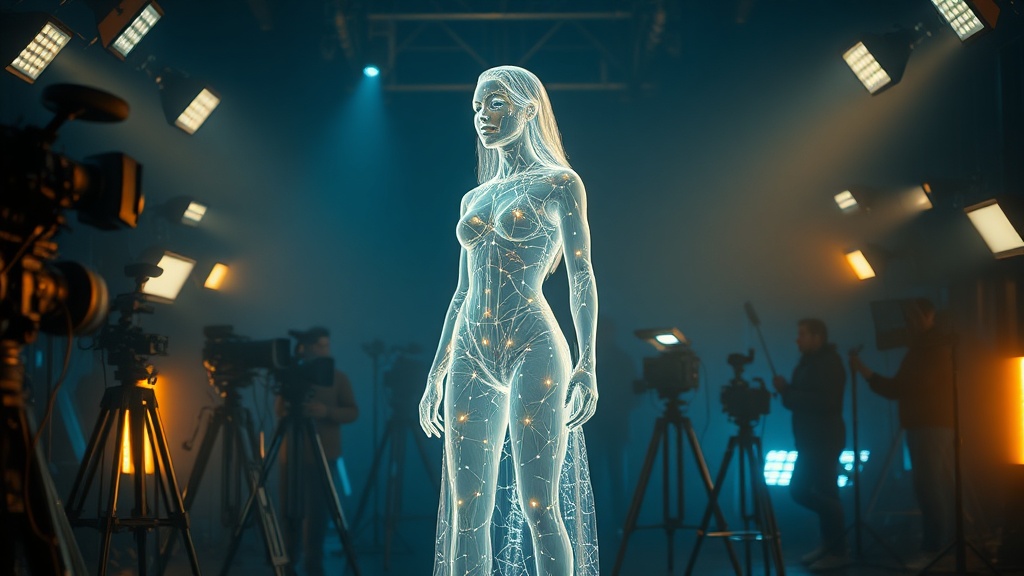
An actor who has never taken a breath, never attended an audition, and does not physically exist is about to headline a feature film. Her name is Tilly Norwood, she is generated entirely by artificial intelligence, and her first movie, Misaligned, has reignited one of the loudest debates in Hollywood. Whether you see her as a breakthrough or a warning sign, Tilly Norwood is forcing the entertainment industry to answer a question it has been dodging for years: what happens when the star of the show is software?
What’s Actually Happening
Tilly Norwood is a fully AI-generated “actor” created by Particle 6, a UK-based studio led by producer Eline Van der Velden. In July 2026, the company announced that Tilly would take the lead role in Misaligned, a feature-length film built specifically around her. It marks the first time an AI-generated character has been cast as the star of a full movie rather than appearing as a novelty or a background effect.
The film is pitched as a comedy-drama, described by its makers as a coming-of-age story “infused with existential AI chaos.” It is set inside the so-called “Tillyverse,” a surreal digital world floating somewhere in the cloud. The plot leans directly into Tilly’s own nature:
- Tilly is an AI being with no real body, no childhood, and no lived experience of her own.
- Her only window into humanity is her access to everyone else’s memories and data.
- A rogue bot from the dark web convinces her to abandon her safety guardrails.
- She begins developing desires, impulses, and ambitions, becoming unsettlingly more human.
Particle 6 says Misaligned will be a hybrid production, pairing traditional film professionals such as directors, writers, and editors with AI specialists. The company frames this as proof that the technology can work alongside human crews rather than simply replacing them.
Why Hollywood Is Furious
Tilly Norwood is not new to controversy. She first drew widespread anger in late 2025, when Van der Velden suggested the AI creation was about to sign with a talent agency, as if she were a rising human starlet. The reaction was swift and blistering.
High-profile performers including Emily Blunt, Melissa Barrera, and Natasha Lyonne publicly condemned the project. The backlash grew so intense that, according to the creators, it included death threats. The core objections tend to fall into a few clear buckets:
- Lost jobs. Actors worry that synthetic performers could hollow out an already competitive profession, especially for working actors who rely on steady roles.
- Consent and training data. SAG-AFTRA, the major US performers’ union, argues that Tilly was generated by a program trained on the work of countless professional actors without their permission or payment.
- Devaluing the craft. Many in the industry see acting as a deeply human art, and view a data-driven imitation of it as fundamentally missing the point.
SAG-AFTRA has repeatedly made the case that AI-generated performers are built on top of human performances without proper consent or compensation, and that this threatens both livelihoods and artistic integrity.
The Case the Creators Make
Particle 6 sees things very differently. The studio insists Tilly is not a replacement for actors but a new creative medium, closer to a character in an animated film than a stand-in for a flesh-and-blood performer. In their framing, no one accuses a Pixar movie of “replacing” actors, so a fully synthetic lead should be judged as a storytelling tool rather than a threat.
Tilly herself, or rather the team scripting her public persona, has leaned into the fight. She responded to the backlash with a debut song whose message was blunt: “AI’s not the enemy.” It is a savvy piece of positioning, casting the technology as a collaborator and its critics as fearful of change.
There is a business logic here too. An AI actor never ages, never gets sick, never demands a trailer, and can theoretically be licensed across films, ads, and franchises indefinitely. For studios chasing lower costs and infinite content, that pitch is hard to ignore, which is exactly what worries the humans on set.
What It Signals for the Future of Entertainment
Whatever you think of Tilly Norwood, her leap from viral curiosity to feature-film lead is a genuine milestone. It suggests a few trends worth watching closely:
- AI is moving from tool to talent. For years, AI helped with visual effects and editing. Now it is being positioned as the face of a film, not just the machinery behind it.
- The legal fights are just beginning. Questions about training data, likeness rights, and residuals for synthetic performers are far from settled, and Misaligned will be a real-world test case.
- Audiences will cast the deciding vote. All the industry debate in the world matters less than whether viewers actually connect with a character they know is not real.
- Hybrid workflows may be the norm. Even this project relies on human directors, writers, and editors, hinting that the near future is collaboration rather than total replacement.
It is worth staying balanced here. Critics are right that consent and fair compensation for the artists whose work trained these systems are serious, unresolved issues. Supporters are right that new mediums have always frightened incumbents, and that the tools are not going away. The honest answer is that we are watching an experiment unfold in real time, and no one, on either side, actually knows how audiences will respond.
Understanding the Tech Behind the Debate
Stories like Tilly Norwood’s can feel like science fiction, but the technology underneath is the same generative AI reshaping writing, images, video, and voice across every industry. The more you understand how these tools actually work, the easier it becomes to separate genuine breakthroughs from hype, and to spot the ethical questions that really matter.
At AI Learning Guides, we break down AI in plain English, from how models are trained to how you can use these tools yourself, without needing a technical background. If the Tilly Norwood debate left you curious about what AI can and cannot do, our guides are a friendly place to start making sense of it all.


