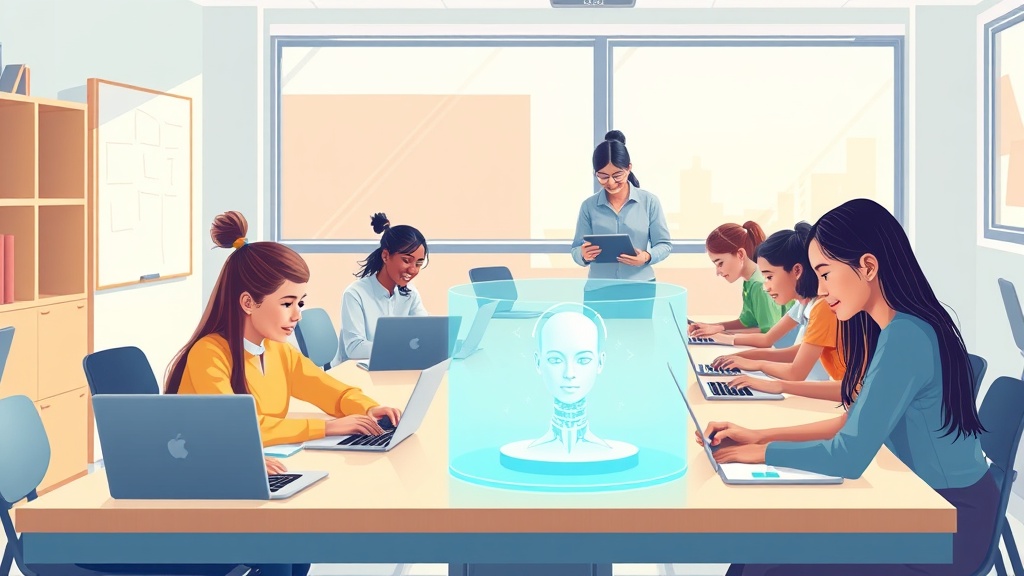
Artificial intelligence didn’t sneak into education in 2026 — it moved in and unpacked its bags. What was a nervous experiment two years ago is now a daily routine for students and, increasingly, for the teachers who once feared it. But the numbers tell a more complicated story than “robots are doing the homework.”
Student use is now nearly universal
The headline is simple: almost every student is using AI. A widely cited 2026 survey of UK undergraduates by HEPI and Kortext found that 92% of students now use AI tools, a sharp jump from 66% just a year earlier. In the US, roughly 84% of high school students report using generative AI for schoolwork, with about 69% of them reaching for ChatGPT specifically.
What are they actually doing with it? Mostly the unglamorous stuff:
- Research and brainstorming — the most common use across every age group.
- Essay drafting and editing — about 56% of K-12 students who use AI use it here.
- Studying for tests and quizzes — roughly 52% use AI as a study buddy.
Two-thirds of students say they now use AI daily or weekly. It has quietly become as normal as a search engine or a calculator.
Teachers are catching up — and getting hours back
The bigger shift in 2026 is on the other side of the desk. A US survey of more than 2,200 teachers found that 60% now use AI tools, rising to 66% among high school teachers and 69% among early-career educators. The payoff is concrete: teachers who use AI at least weekly report saving about 5.9 hours per week, mostly on routine tasks like lesson planning, grading drafts, and drafting parent emails.
That time-savings is a big reason the resistance is fading. When a tool hands a teacher back most of a working day each week, “should we allow this?” quickly becomes “how do we use this well?”
Does it actually help students learn?
Early evidence is genuinely encouraging, with one important caveat. A 2025 Harvard physics study found that students working with an AI tutor learned more than twice as much in less time than peers in a traditional active-learning classroom. Coursera’s February 2026 report echoed the sentiment: four in five students said AI had improved their academic performance.
Dedicated tutoring tools are scaling fast, too. Khan Academy’s Khanmigo has become a reference point for AI tutoring, reaching millions of students and hundreds of district partnerships. The promise is personalized, patient, one-on-one help — the kind that used to be available only to families who could pay for a private tutor.
Where schools are still scrambling
Here’s the honest part: adoption has raced ahead of the rulebook. Surveys in 2026 found that only about half of middle and high schools have any AI policy at all, and just a tiny fraction of teachers describe their school’s policy as “clear.” That gap creates real problems — confusion over what counts as cheating, uneven access between well-funded and under-funded schools, and legitimate worry from parents that leaning on AI could erode students’ critical-thinking skills.
The tools are also not magic. AI still invents facts, flatters bad ideas, and can quietly do the thinking a student was supposed to do. The schools getting the most out of AI in 2026 aren’t the ones that banned it or the ones that let it run wild — they’re the ones teaching students how to use it: to check its output, to use it as a starting point rather than a finish line, and to know when to close the laptop and think for themselves.
What it means for learners in 2026
The lesson of 2026 is that AI literacy is no longer optional — for students, teachers, or parents. Knowing how to prompt well, verify answers, and use these tools ethically is quickly becoming as fundamental as reading a syllabus. The students who thrive won’t be the ones who use AI the most; they’ll be the ones who use it the most wisely.
Want to build those skills the right way? Our plain-English AI guides walk you step by step through using tools like ChatGPT for studying, research, and writing — without letting them do your thinking for you. Browse our guides and start learning with AI, not just leaning on it.


