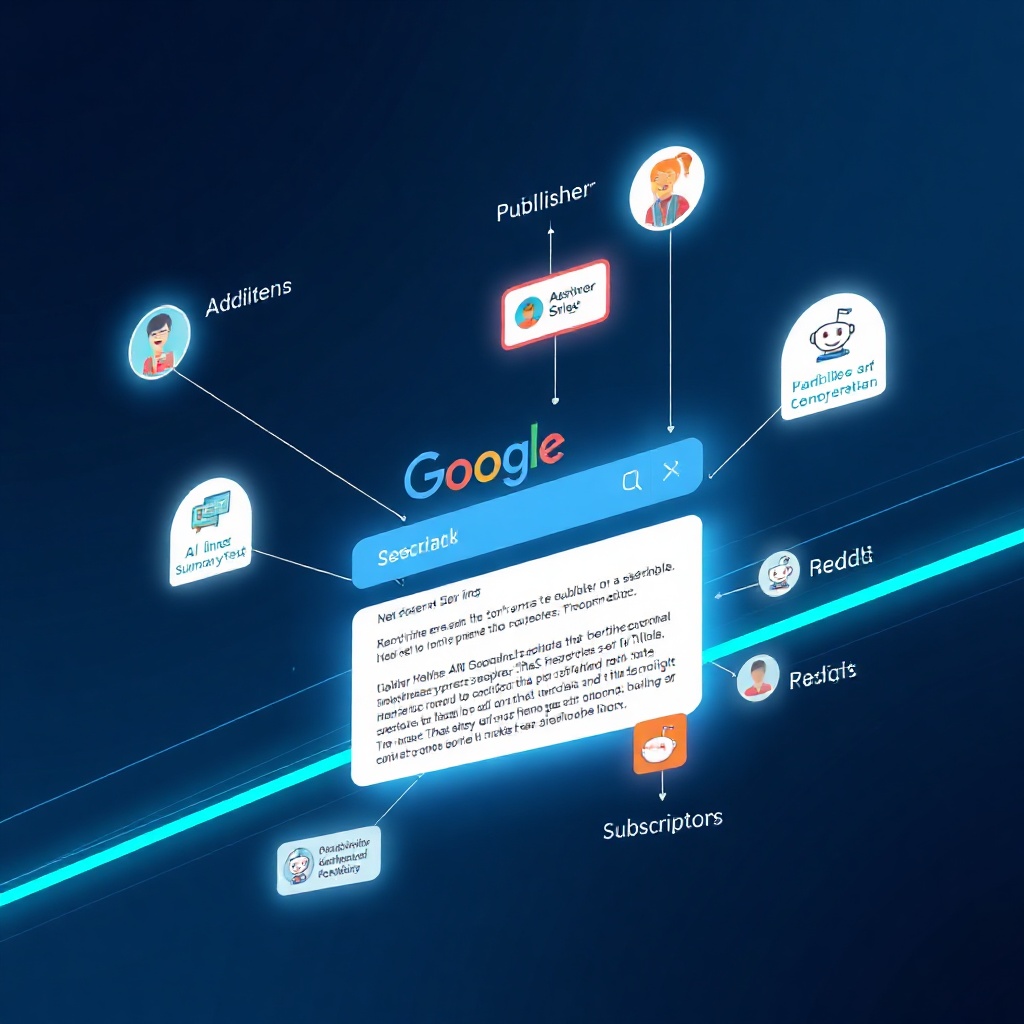
Google rolled out the most consequential change to Google AI Mode and AI Overviews since the products launched. On May 6, 2026, Google shipped five new linking features that move source links from buried footnotes to inline placement next to the generated text, badge subscription content the user pays for, surface social and discussion sources with creator attribution, suggest next-step angles at the end of every response, and add hover previews on desktop. For publishers, SEOs, and content marketers, the changes reshape how AI-driven search drives traffic.
What’s actually new
Google AI Mode and AI Overviews are the two surfaces that now serve generative answers in Google Search. AI Overviews appear above the traditional search results for many queries; AI Mode is the dedicated full-page conversational search experience launched broadly in 2025. Both have been criticized since launch for compressing the source web into summaries that did not always credit or link prominently to publishers. The May 6 update is Google’s most direct response to that criticism.
The first change is inline link placement. Links now appear directly next to the relevant sentence in the generated response, not aggregated at the bottom or in a side panel. If the AI states a fact, the link to the source sits inline with that fact. The result is a denser visual cue that publishers are being credited and a cleaner click path for users who want to verify or dig deeper.
The second change is subscription badges. When a user is signed in to a Google account that has authenticated news subscriptions (linked through Google News or the Subscribe with Google program), AI responses now highlight links from those subscriptions explicitly. Google’s testing found users clicked subscription-labeled links at meaningfully higher rates. The change is a direct push to drive value back to publishers who have invested in paid subscriptions.
The third change is social and discussion attribution. AI responses now surface “perspectives from public online discussions, social media, and other firsthand sources” with creator names, handles, or community names visible. This is a fundamental shift in how Google treats user-generated content in AI search. Reddit threads, X posts, YouTube comments, niche forum discussions, and similar firsthand sources can now appear with attribution in AI responses, which is a meaningful new acquisition channel for community-driven publishers.
The fourth change is suggested angles. At the end of many AI responses, Google now shows a curated set of links to articles offering different perspectives or deeper analyses on related facets of the topic. The placement is at the bottom of the response, after the user has already absorbed the AI’s summary, with an explicit invitation to explore further. The pattern is closest to the “related stories” pattern news sites have used for years, but with Google’s editorial judgment about what counts as a quality angle.
The fifth change is hover previews on desktop. When a user hovers over an inline link, a small preview surfaces showing the page title and the publisher name. The pattern reduces the cost of evaluating whether to click and increases the click-through rate on the links that look most relevant. Mobile retains the simpler tap-to-visit pattern; the hover preview is desktop-only.
Why it matters
- Click-through rates on AI Overviews should rise materially. Inline placement, subscription badges, and hover previews all reduce friction for users who want to follow a source link. Early estimates from SEO firms suggest 15 to 35 percent CTR improvements on AI Overview links in the first thirty days, though Google has not published its own numbers.
- The publisher economics of AI search just got more defensible. The 2024 critique that AI Overviews would cannibalize publisher traffic was partly correct; the May 6 update walks back some of the cannibalization by making linked traffic easier to capture.
- Subscription content gets a structural boost. The subscription badge is the single most direct signal Google has ever sent that paid content is preferred for users who already pay for it. Publishers investing in subscription products just got a tailwind they did not have a week ago.
- Reddit, X, and niche communities became inventory. The community attribution change means AI Overviews can now drive traffic to specific discussions, posts, and creators. The shift is small but compounds for community-driven sites and influencer-driven niches.
- SEO tactics have to adjust quickly. Structured data, byline clarity, subscription tagging, and explicit firsthand-source markup all become more important. The SEO community is reading the changes carefully because tactical responses are time-sensitive.
- Google is fighting back against ChatGPT and Perplexity. Both competitors have positioned themselves as more publisher-friendly than Google’s AI search. The May 6 update is Google’s direct rebuttal and signals more publisher-friendly moves to come.
How to use it today
For publishers, SEOs, and content marketers, the window to optimize for the new format is narrow because every competitor is reading the same change notes. The fastest wins are mechanical: make sure your content surfaces the signals Google now rewards. The deeper wins are structural: produce content that is genuinely a first-hand source on something the AI cannot easily synthesize from elsewhere.
- Audit your structured data. Make sure NewsArticle, Article, FAQ, and HowTo schema are correctly implemented on every relevant page. The schema is the substrate Google reads when deciding whether to link to your content inline.
- Tag subscription content explicitly. Add the appropriate Subscribe with Google or Google News subscription markup so the AI knows your paid content qualifies for the subscription badge.
- Build first-hand source signals. Bylines with author bio pages, original photography with EXIF data, original research with documented methodology, direct quotes with named attribution. The AI rewards content that looks like firsthand reporting.
- Strengthen your social and community presence. The community attribution change creates an opportunity for branded social accounts and community moderation that produces quote-worthy threads.
- Monitor your AI Overview impressions and clicks. Google Search Console added AI Overview-specific reporting in 2025; the May 6 changes affect this data materially. Track the trend through May and June to see how the new format affects your traffic.
- Iterate on the angle suggestions. Look at the suggested angles Google surfaces at the bottom of AI responses for your target queries. Each angle is a content opportunity; write the version Google will surface.
The Search Console API exposes the AI Overview impression and click metrics if you want to track them programmatically. The minimum query looks like this.
from google.oauth2 import service_account
from googleapiclient.discovery import build

creds = service_account.Credentials.from_service_account_file(
    "sc-creds.json",
    scopes=["https://www.googleapis.com/auth/webmasters.readonly"],
)
service = build("searchconsole", "v1", credentials=creds)

request = {
    "startDate": "2026-05-06",
    "endDate": "2026-05-13",
    "dimensions": ["page", "query"],
    "type": "discover",
    "searchType": "web",
    "dimensionFilterGroups": [{
        "filters": [{
            "dimension": "searchAppearance",
            "operator": "equals",
            "expression": "AI_OVERVIEW",
        }],
    }],
    "rowLimit": 5000,
}

response = service.searchanalytics().query(
    siteUrl="https://example.com/", body=request,
).execute()

for row in response.get("rows", []):
    print(row["keys"], row["clicks"], row["impressions"], row["ctr"])
For structured data testing, Google’s Rich Results Test remains the canonical check. For schema implementation, JSON-LD remains the recommended format. The example below shows the subscription markup Google now reads when deciding whether to badge a link.
<script type="application/ld+json">
{
  "@context": "https://schema.org",
  "@type": "NewsArticle",
  "headline": "Original investigation: city plumbing failure",
  "author": {"@type": "Person", "name": "Jane Doe", "url": "https://example.com/author/jane"},
  "datePublished": "2026-05-11T08:00:00-04:00",
  "publisher": {"@type": "NewsMediaOrganization", "name": "Example News"},
  "isAccessibleForFree": false,
  "hasPart": {"@type": "WebPageElement", "isAccessibleForFree": false, "cssSelector": ".paywall"}
}
</script>
How it compares
Three serious AI search products now compete on how they treat publisher links. The table below compares the major contenders as of May 11, 2026.
| Product | Link placement | Subscription handling | Community sources | Hover previews | Publisher friendliness (May 2026) |
|---|---|---|---|---|---|
| Google AI Overviews / AI Mode | Inline next to relevant text | Explicit subscription badges | Reddit, X, forums with attribution | Desktop hover previews | Materially improved on May 6 |
| ChatGPT Search | Inline citations with publisher logo | Partner-tier subscription previews | Limited; mostly news partners | Inline footnote previews | Strong, partner-publisher focused |
| Perplexity | Inline numbered citations | Limited; subscription publishers tier | Reddit, X, forums included | Inline footnote previews | Strong, broad source coverage |
| Microsoft Copilot Search | Inline links and side panel | Edge integration with paywalled sites | Limited | Side panel previews | Strong inside Edge browser |
| Brave Leo / Search | Source citations at bottom | Not yet | Limited | None | Privacy-focused, lighter on publishers |
The competitive read: Google just closed most of the gap with ChatGPT Search and Perplexity on publisher-friendliness. The differentiation now sits less in linking philosophy and more in distribution (Google still has the largest search audience by a wide margin) and in how each product treats specific publishers under specific licensing arrangements. The patchwork of publisher deals (News Corp with OpenAI, Conde Nast with various, AP with multiple) increasingly determines where any given publisher gets the strongest treatment.
What’s next
Three threads to watch over the next sixty days. First, Google’s June 2026 round of Search announcements at Google I/O follow-ups and Search Central Live; expect further publisher-facing changes, possibly including revenue-share mechanisms that go beyond click-through monetization. Second, the SEO community’s tactical response will mature quickly; tools like Semrush, Ahrefs, and Sistrix will ship AI Overview-specific reporting modules that surface the new opportunities. Third, expect lawsuit and antitrust developments around the broader question of how AI search uses publisher content; the May 6 changes are partly a response to legal pressure as well as commercial pressure.
The longer arc is that AI search is finding the economic model that lets the open web survive while serving generative answers. The May 6 changes are not the final answer, but they are a meaningful step toward a stable equilibrium. Publishers who adapt to the new format will benefit; those who treat AI search as a zero-sum threat will continue to lose ground.
Frequently Asked Questions
Do I need to change my SEO strategy because of this?
Yes, but the changes are incremental, not foundational. Continue producing strong content. Make sure your structured data is current, your bylines are clear, and your subscription markup (if you have paid content) is correctly implemented. The May 6 update rewards content that is well-structured and clearly first-hand; the SEO playbook for getting there is the playbook you should have been running already.
Will subscription badges drive new subscribers?
Modestly, yes. The subscription badge does not actively recruit new subscribers; it benefits publishers whose existing subscribers see their paid content surface more prominently in AI search. The compounding effect is in subscriber retention and per-subscriber value, not in subscriber acquisition directly.
Does this affect AI Mode differently than AI Overviews?
The five changes apply across both surfaces, but AI Mode is the more conversational format and benefits more from the suggested-angle and hover-preview changes. AI Overviews benefit most from the inline link placement and subscription badge changes because of their more structured, summary-style format.
How are community sources like Reddit treated?
Public discussions on Reddit, X, and similar platforms can now surface as cited sources in AI responses with creator-name or community-name attribution. The attribution is visible to users, which makes the original poster or community more discoverable. Private or gated communities are not included; only publicly accessible discussions qualify.
What does the hover preview show?
Hovering over an inline link on desktop surfaces the page title and the publisher or website name in a small preview. The preview does not show full article content. The pattern is similar to Wikipedia’s article-preview hover behavior. Mobile uses a simpler tap-to-visit model without the hover affordance.
Should I expect more traffic from AI Overviews now?
Most publishers should expect modest traffic uplift from the inline link placement and hover preview changes. Publishers with subscription products and active community presences should expect larger uplift because of the badge and attribution features. Track the trend through May and June to see how your specific content category is affected.
Go deeper than this article
This article covers the essentials. Our premium eguide library gives you the full step-by-step playbooks — prompts, workflows, and copy-paste recipes you can put to work today.


