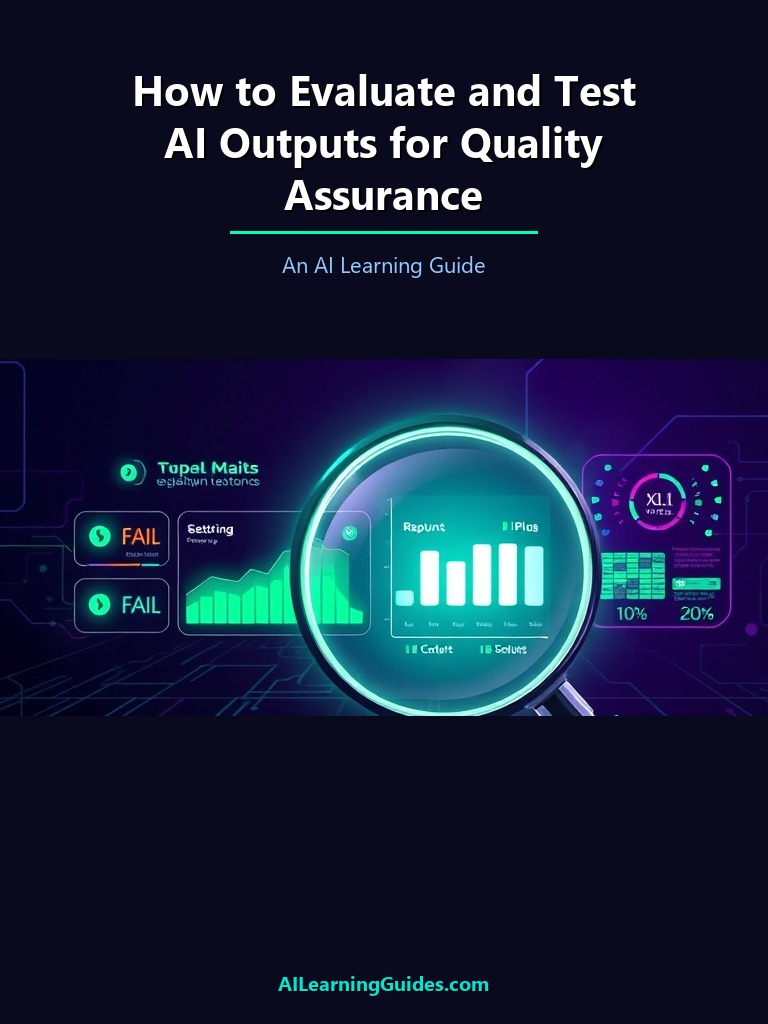
The landscape of AI output evaluation is shifting rapidly. In 2026, relying on manual checks or outdated metrics for quality assurance means falling behind. Poorly evaluated AI outputs lead to flawed products, inaccurate insights, and significant reputational damage. This guide addresses the critical need for robust, AI-driven quality assurance frameworks, ensuring your models deliver reliable, high-performing results in an increasingly automated world. Master the techniques to validate AI performance and maintain competitive edge.
This eguide is for data scientists, ML engineers, QA professionals, and product managers responsible for deploying and maintaining AI systems. If you’re tasked with ensuring the integrity of generative AI, predictive models, or automation tools, this guide provides the actionable strategies you need. After reading, you will confidently design evaluation protocols, interpret complex performance metrics, and implement continuous improvement loops for any AI application, from large language models to specialized computer vision systems.
We built this eguide with an operator-level focus, detailing specific tools and methodologies relevant to 2026. Expect deep dives into current platforms like Weights & Biases, MLflow, and Hugging Face Evaluate. The tone is direct and honest, cutting through theoretical fluff to provide concrete steps for real-world application. You’ll find practical examples, prompt structures for evaluation, and common pitfalls to avoid, all designed to elevate your AI quality assurance processes immediately.
What This Guide Covers
- Designing comprehensive evaluation metrics for generative AI outputs, including perplexity, ROUGE, and BLEU scores.
- Implementing human-in-the-loop (HITL) feedback systems for subjective AI quality assessment using platforms like Scale AI or Appen.
- Setting up automated testing pipelines for AI models using CI/CD tools like GitLab CI with DVC for data versioning.
- Evaluating fairness and bias in AI outputs with tools like IBM AI Fairness 360 and Google’s What-If Tool.
- Monitoring AI model drift and data shift in production environments using Evidently AI or Arize AI.
- Establishing clear pass/fail criteria for AI-generated content in regulated industries.
- Benchmarking AI model performance against established baselines and competitor models using public datasets.
- Utilizing synthetic data generation to create diverse and challenging test cases for AI systems.
- Performing adversarial testing to identify vulnerabilities and failure modes in AI outputs.
- Quantifying the business impact of AI output quality, linking evaluation metrics to ROI.
- Strategies for continuous learning and adaptation in AI evaluation frameworks as models evolve.
- Best practices for documenting AI evaluation processes for auditability and compliance.
- Integrating explainable AI (XAI) techniques, such as SHAP or LIME, into quality assurance workflows.
- Managing and versioning evaluation datasets and metrics using MLflow Tracking.
The pattern that wins in 2026 for AI quality assurance is a hybrid approach: automated, metric-driven evaluation augmented by targeted human oversight. This combination ensures both scalability and the nuanced understanding required for complex AI outputs, driving trustworthy and high-performing AI systems.




Reviews
There are no reviews yet.