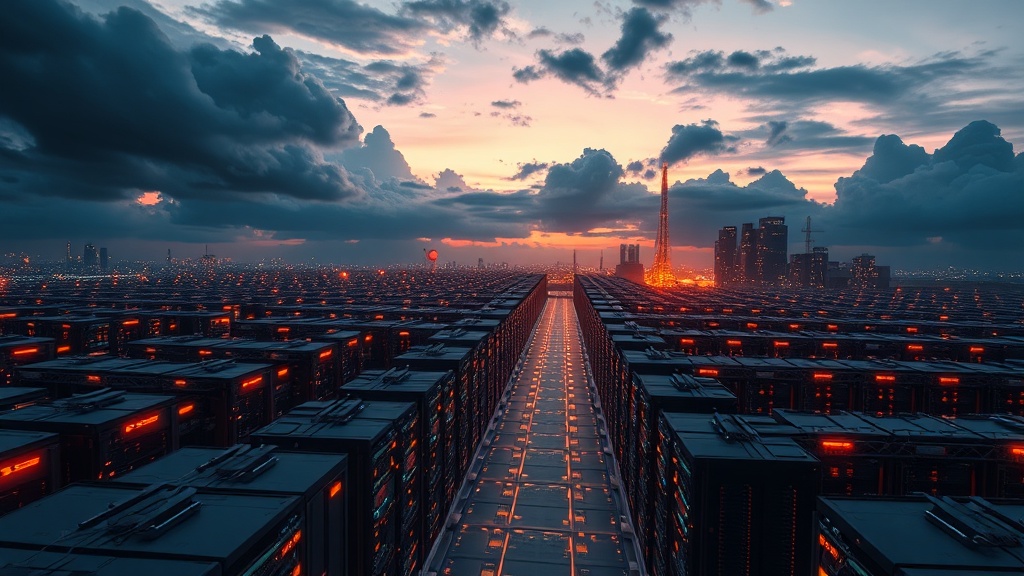
The race to build powerful AI has quietly turned into something much more physical: a race to build the machines that run it. In the span of a few weeks, two of the biggest names in technology made moves that put the spotlight squarely on compute and chips. Alphabet, Google’s parent company, unveiled plans to raise roughly $80 billion to expand its AI infrastructure. And OpenAI, alongside chipmaker Broadcom, revealed its first custom silicon, an inference chip with the memorable codename Jalapeno. Together, these announcements signal that the next phase of the AI boom will be won or lost in factories, data centers, and fabrication plants, not just in research labs.
Why compute became the real battleground
For years, the story of AI was about clever algorithms and bigger models. That is still true, but there is a catch that has become impossible to ignore: every one of those models needs enormous amounts of computing power to train and, increasingly, to run for millions of users every day. That computing power comes from specialized chips, mountains of memory, fast networking, and buildings full of servers that drink electricity and require constant cooling.
Compute has become the bottleneck. If you cannot get enough chips, or cannot afford to run them, it does not matter how brilliant your model is. That is why the arms race has shifted. The companies with the deepest pockets and the best supply chains are gaining a structural advantage. In plain English, whoever controls the hardware increasingly controls the pace of AI progress.
- Training a frontier model can cost hundreds of millions of dollars in compute alone.
- Inference, the act of actually answering your questions, now runs at massive scale and can cost more over time than training ever did.
- Energy and real estate have become genuine constraints, with data centers competing for power grids and land.
Google’s giant $80 billion bet
Alphabet’s move is striking for its sheer size. The company is looking to raise around $80 billion in fresh capital, in what has been described as one of the largest equity financings in corporate history. The structure gives a good sense of how serious this is. It reportedly includes roughly $30 billion in public stock offerings, a $40 billion at-the-market program that lets the company sell shares gradually, and a headline-grabbing $10 billion private investment from Warren Buffett’s Berkshire Hathaway.
That last detail matters. Berkshire Hathaway is famous for its cautious, value-focused approach and its historical reluctance to pile into flashy tech. Its decision to put $10 billion behind Google’s AI build-out is a strong vote of confidence that this spending is not a bubble but a long-term infrastructure play. Alphabet has signaled that its total capital expenditure for the year could climb toward the $190 billion range, with much of it aimed at scaling global compute.
The message from Google is blunt: it intends to build so much AI capacity that competitors simply cannot keep up. In an industry where compute is king, an $80 billion war chest is a way of buying the throne.
OpenAI builds its own silicon: meet Jalapeno
While Google is buying capacity at scale, OpenAI is taking a different but complementary path: designing its own chip. In partnership with Broadcom, OpenAI revealed Jalapeno, its first custom-built processor. What makes it notable is that it is not a repurposed training chip or a general-purpose accelerator. It is a purpose-built inference chip, engineered specifically for the job of running large language models efficiently once they are already trained.
The technical claims are ambitious. OpenAI says Jalapeno was taken from initial design to manufacturing tape-out in just nine months, an unusually fast timeline, and that it used its own AI models to help accelerate parts of the design process. Early engineering samples are reportedly running real workloads in the lab, including OpenAI’s own models, and the company claims performance per watt substantially better than the current state of the art. Jalapeno is described as the first step in a multi-generation platform, with initial deployment targeted for the end of 2026.
OpenAI is not alone in this. Building custom silicon has become a defining trend among the biggest AI labs and cloud providers. The logic is simple:
- Cost control — designing your own chip can dramatically lower the price of running models at scale.
- Efficiency — a chip tuned for one job wastes less energy than a general-purpose one.
- Independence — owning your hardware reduces reliance on a single supplier and its pricing.
What it means for AI progress and costs
So what does all of this mean for the rest of us? In the near term, it points to faster progress and, eventually, cheaper AI. The whole reason to spend tens of billions on compute and design custom chips is to make each answer, image, and line of code cheaper and quicker to produce. As inference costs fall, the AI tools you already use should get better, faster, and more affordable, and entirely new applications become viable.
There is a flip side worth watching. This level of spending concentrates power in the hands of a small number of very large players who can afford it. It raises real questions about competition, energy consumption, and whether the returns will ever justify the staggering upfront cost. For now, though, the market is treating compute as the single most valuable resource in technology, and companies are behaving accordingly.
The takeaway is clear. The AI story has moved beyond software. It is now about infrastructure, silicon, and scale, and the winners will be decided as much in the data center as in the research paper.
Keep up without the jargon
The world of AI compute can feel overwhelming, full of acronyms and billion-dollar headlines. It does not have to be. At AI Learning Guides, we translate these fast-moving stories into plain English and practical skills you can actually use, whether you are curious about how these tools work or ready to put them to work for your business. Explore our guides and stay a step ahead as the arms race unfolds.


