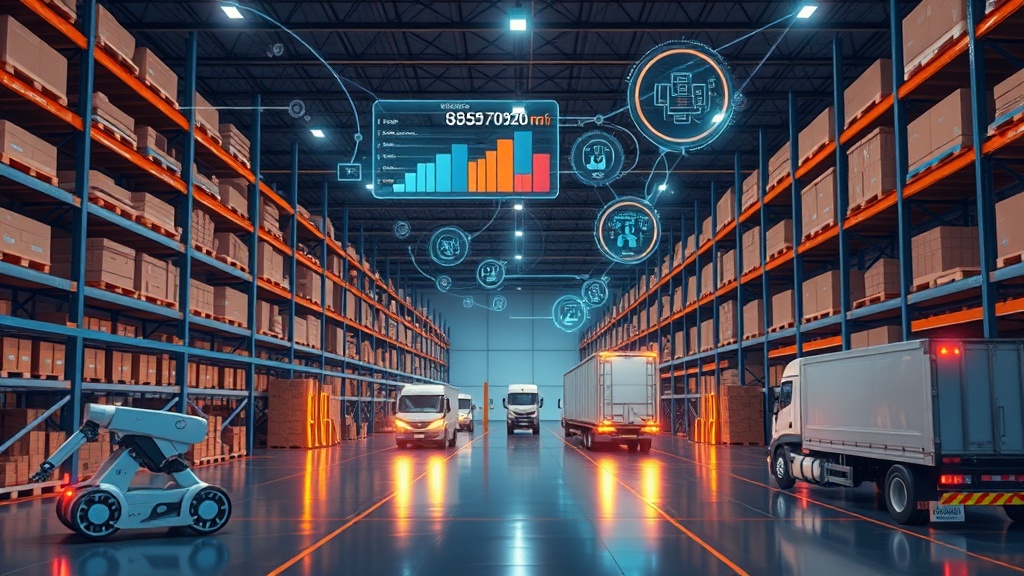
The global supply chain spent the early 2020s recovering from shocks it never saw coming. In 2026, the industry is finally going on offense, and artificial intelligence is the weapon of choice. What began as flashy pilot projects has hardened into production systems running warehouses, planning routes, and forecasting demand in near real time. The numbers behind this shift are no longer speculative, they are landing on balance sheets.
Agentic AI Becomes the Headline Trend of 2026
The buzzword of the year is agentic AI, a class of systems that can plan, act, and adapt toward a goal rather than simply answering a prompt. Gartner named agentic AI and physical AI as the top supply chain technology trends for 2026, describing agents as a virtual workforce operating inside complex logistics environments. The growth forecast is staggering: Gartner projects that supply chain management software with agentic AI capabilities will grow from less than 2 billion dollars in spend in 2025 to 53 billion dollars by 2030.
Adoption is expected to follow the money. Gartner estimates that 60 percent of enterprises using SCM software will have adopted agentic AI features by 2030, up from just 5 percent in 2025. In practical terms, that means software that can reroute a shipment, reorder inventory, or renegotiate a delivery window without waiting for a human to click approve.
The Adoption Numbers Behind the Hype
Supply chain leaders are not waiting for the future to arrive. According to industry research compiled for 2026, 94 percent of supply chain companies plan to use AI or generative AI for decision support within two years, and 93 percent of organizations are already exploring or actively deploying generative AI. Logistics has quietly become the most AI-forward corner of the economy, with 72 percent of logistics employees adopting AI tools in 2024, the highest rate of any industry.
Spending intentions confirm the trend. Roughly 85 percent of executives plan to increase AI spending in 2026, and one in five expect increases of 20 percent or more. The AI-in-supply-chain market, valued at 9.94 billion dollars in 2025, is projected to reach 236 billion dollars by 2035.
Where AI Is Actually Delivering Value
The most proven use cases in 2026 are unglamorous but lucrative: inventory optimization, route planning, and demand forecasting. AI-enabled distribution operations are seeing 5 to 20 percent logistics cost reductions, 20 to 30 percent inventory reductions, and 5 to 15 percent lower procurement spend. Companies with AI-mature supply chains are reportedly 23 percent more profitable than their peers.
McKinsey has framed the broader opportunity in trillion-dollar terms, estimating that AI agents could add 2.6 to 4.4 trillion dollars in annual value across business use cases, with supply chain applications among the clearest winners. The message for 2026 is that the returns are real when the technology is aimed at specific, measurable problems.
The Workforce Question Nobody Can Avoid
The efficiency gains come with a human cost that leaders are now openly discussing. A Gartner survey found that 55 percent of supply chain leaders expect agentic AI to reduce the need to hire for entry-level positions, and 51 percent believe the technology will drive overall workforce reductions. The bottleneck for 2026, however, is not the technology, it is talent: only 23 percent of supply chain organizations have a formal AI strategy in place, and the skills gap remains the single biggest constraint on faster deployment.
That gap is why ROI often takes time. Even though 85 percent of organizations increased AI investment over the past year, only about 6 percent saw returns in under a year, with most reaching satisfactory ROI within two to four years.
What It Means for Businesses in 2026
The takeaway is that AI in supply chain has crossed from experiment to expectation. The winners will not be the companies that spend the most, but the ones that pair clear strategy with upskilled teams and target AI at concrete problems like forecasting and routing. For everyone else, the risk of standing still grows every quarter.
Want to understand how these AI systems actually work and how to apply them in your own operations? Explore our guides for plain-English playbooks on AI, automation, and the tools reshaping business in 2026.


