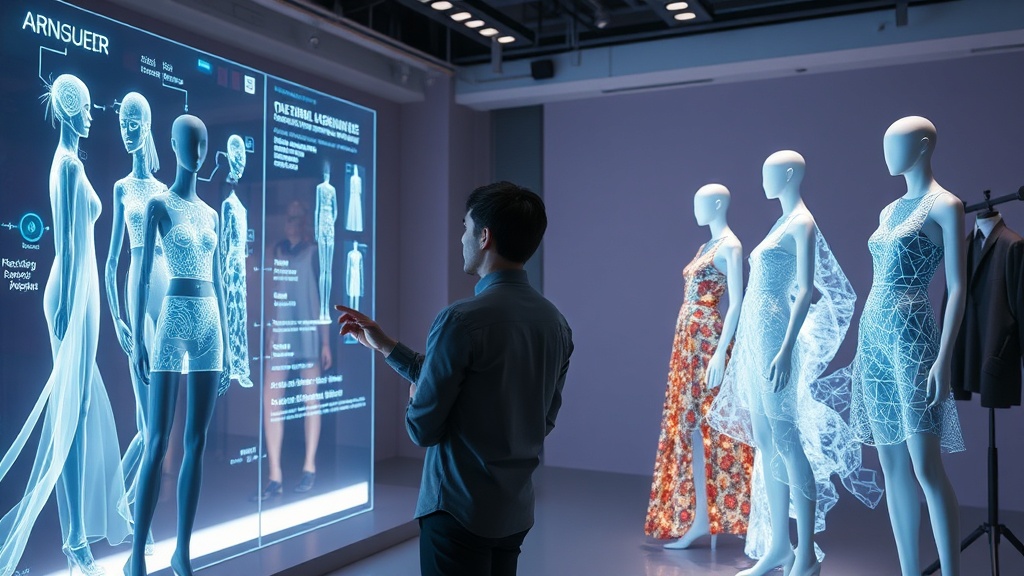
2026 is the year artificial intelligence stopped being a novelty in fashion and became part of the daily workflow. From the design studio to the checkout page, generative tools are compressing timelines, personalizing storefronts, and reshaping how clothes get made and sold. The global AI in fashion market is projected to grow from roughly USD 5.89 billion in 2025 to nearly USD 29.82 billion by 2034, and the pace of adoption this year explains why.
Generative AI Enters the Design Studio at Scale
The headline story of 2026 is that big brands are no longer just testing generative AI. They are embedding it. In February 2026, ASOS rolled out a generative AI toolbox across its design operations and upskilled more than 100 designers to use it. The result was an average time saving of 75 to 80 percent across key design processes, with teams able to instantly explore colorways, fabrics, and design variations that once took days of manual iteration.
The appeal is straightforward. A designer can feed a brief into a generative model and receive hundreds of variations, alternate colorways for an existing garment, and full mood boards in minutes. That does not replace human taste; it removes the grunt work between an idea and a presentable concept, letting creative teams explore more directions in less time.
Virtual Try-On Goes Mainstream
Virtual try-on has been promised for years, but 2026 is when it finally started moving the numbers. In January 2026, Zara introduced interactive virtual try-on experiences that let shoppers preview outfits digitally before buying. The goal is practical: reduce return rates while boosting buyer confidence at the moment of purchase.
Behind many of these experiences sits Perfect Corp, which now works with more than 800 client brands worldwide. Its generative AI fashion APIs let shoppers upload a photo and see watches, rings, hats, shoes, and bags on themselves. According to industry reporting, retailers integrating these digital garment trials are seeing online conversion rates lift by as much as 40 percent and return costs cut by nearly half. In an industry where returns quietly destroy margins, those are numbers that get executive attention.
Trend Forecasting Powered by Real-Time Data
AI is also changing how brands predict what people will want. Modern trend forecasting systems monitor millions of social media posts, street style photographs, runway images, and search queries in real time to spot emerging aesthetic signals before they hit the mainstream. Instead of a designer guessing what will be hot in 18 months, brands increasingly lean on data-driven signals to plan collections, allocate inventory, and reduce the overproduction that has long plagued fashion.
This shift matters beyond aesthetics. Fashion is one of the most wasteful industries on the planet, and unsold inventory represents both financial loss and environmental cost. By reading demand signals earlier and more accurately, AI forecasting lets brands produce closer to actual appetite. Several 2026 reports point to smaller, more frequent drops informed by live data rather than the traditional two-season calendar, a change that favors agility over guesswork.
The Runway Itself Is Getting an AI Makeover
Generative tools are not confined to spreadsheets and product pages. Brands are using models like Stable Diffusion and generative adversarial networks to produce virtual runway presentations. Balenciaga has leaned into the spectacle, featuring AI-generated holographic models and AI voice narration in its shows. Meanwhile, smart mirrors and RFID-enabled interactive fitting rooms, like those Guess deployed with Alibaba’s FashionAI, are turning physical stores into responsive, data-aware spaces.
What It Means for Designers and Shoppers
The through-line across all of this is speed and personalization. Personalization engines can now serve entirely different product visuals to every shopper based on a unique taste profile. Key 2026 themes include multimodal AI design agents, virtual 3D prototyping, reactive smart textiles, and enterprise design engines. For independent creators, a wave of affordable AI design tools has lowered the barrier to producing professional concepts without a full studio behind them. The risk, as always, is homogenization and the erosion of original craft, which is why the brands winning in 2026 treat AI as a collaborator, not a replacement.
Want to actually use these tools instead of just reading about them? Our step-by-step AI guides break down generative design, image tools, and prompt techniques in plain language so you can put them to work today. Explore our guides and start building with AI.


